Archive for the ‘Google’ Category

Rumored Google Maps Changes Could Involve Google+

Monday, September 12th, 2011

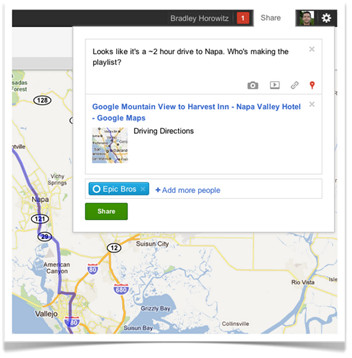
Google Plus + Google MapsOver the weekend, I received a credible rumor from one of the larger companies I work with. Purportedly, they were contacted by their Google Ads rep and urged to purchase more advertising now, inadvance of some “big changes” planned to happen on October 1.

It’s still early, and I haven’t been able to confirm this rumor as of yet, despite putting out feelers to a number of sources. However, it feels believable because Google Plus has promised rollout of business Plus pages at some point, and it would make very good sense in the case of local businesses to have their (more…)

Google’s New Content Delivery Network (CDN)

Friday, July 29th, 2011

Google Page Speed Service - Content Delivery Network CDNI posted a piece about Google’s new “Page Speed Service” over on SEM Clubhouse this morning, and in it I describe a bit of how it will speed up websites and thus help with both SEO and user-experience. Those are mostly good things.

But, I go on to compare it a little with old AOL service processes. Like the old AOL service, which used to compress and cache webpages across the internet (sometimes changing those pages for the worse), the Google service is also a little disturbing in the “Big Brother” sense.

Google, through search, already occupies so much of consumers’ time on the internet, and it’s often the first leg or starting-off-point for many consumers’ web interactions. If large numbers of websites also use the Page Speed Service, then Google could be hosting the entire end-to-end experience for the internet.

If they start using their dark fiber network as part of the routing of this new Content Delivery Network, one’s internet usage moves partially off of the shared public grid onto a completely private network. Your user experience would not necessarily be altered, but it’s disturbing from the standpoint of it beginning to build a defacto “walled-garden” experience upon the infrastructure of a single company which begins to resemble the mother of all monopolies.

When an internet experience (or mobile access experience) is completely within a silo, it risks having all sorts of odd rules imposed upon it. Such as a lack of network neutrality, the forcible intrusion of unwanted ads, snooping, and outright suppression of materials not deemed to be in the best interests of the owner corporation.

While Google has been known for being more philosophically against censorship and suppression, and has been a supporter (to some degree) of net neutrality, the potential for issues if they own the end-to-end web experience expand exponentially. The old adage applies, regardless of good intentions: “It’s not wise to put all your eggs in one basket.”

Google Maps Hates Small Businesses By Launching Local Folksonomy Descriptive Terms

Monday, June 13th, 2011

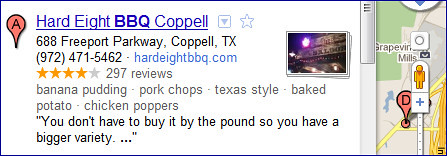
Google has just announced that they’ve launched “Descriptive Terms” to appear with business listings in map search results. According to them, these descriptive terms are some of the most common terms found in user reviews, blogs, web pages and other online references which describe the business. For instance, if you search for “Barbeque Restaurants”, you might see a business which lists such items as “banana pudding”, “pork chops”, “texas style”, “baked potato” and “chicken poppers”:

BBQ Restaurant Descriptive Terms

So, the cool part of this idea is that the feature will highlight user-generated terms which are frequently used in reference to the business. This is a type of an ontology formed by the vox populi, or common man. More properly, these Descriptive Terms begin forming what’s known as a “folksonomy“, which started coming into vogue with social media, particularly around the concept of tag clouds.

(It’s very slightly ironic that Google Maps has now deployed what are essentially small tag clouds with business listings, since I’ve heard some Google Engineers mildly disparage tag clouds as being potentially un-userfriendly and potentially bad on sites in some cases!)

But, the really UNCOOL part of the new Descriptive Terms is that Google appears to’ve launched these willy-nilly without properly safeguarding against sensitive/bad terms that they can end up highlighting.

With very minor testing, I can see numerous instances where the terms selected by the algorithm are inappropriate and unfairly damaging to the businesses. (more…)

Penises Invade Google Maps ♂

Friday, June 10th, 2011

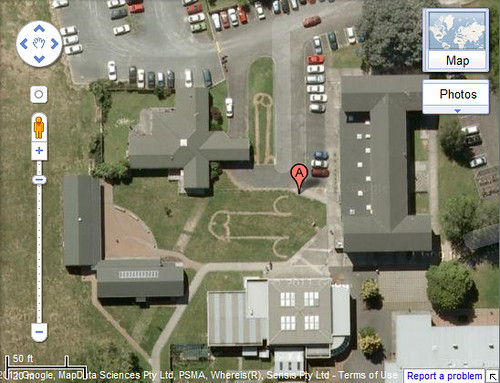
So, we’ve seen UFOs in Google Maps, illegal activites, marriage proposals, earth art, and more. Since I’ve reported on all sorts of cool things to see in Google Maps (including corn field mazes, advertisements, and more), I’ve decided to also report on the latest — a juvenile prank that’s now gotten a lot more publicity than was perhaps originally imagined. Yes, I’m sad to say that penises have now invaded Google Maps!

Penises in Google Maps

It seems that some students at New Zealand’s Fairfield College decided it would be funny to lay down phallic patterns of weedkiller on the school’s lawns, according to Stuff.co.nz. By the time the landscaping maintenance personnel realized what had happened, the penis-shaped patterns were already showing up. The maintenance people tried obliterating the definition of the patterns with more weedkiller, apparently killing all the grass.

But, not before Google’s satellite/aerial cameras caught the scenes. (more…)

Google Site Blocking Feature – An Assault On SEO?

Friday, March 11th, 2011

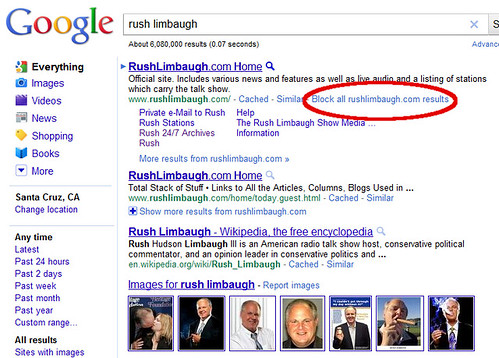
During this week’s SMX West conference, Google announced a new feature whereby searchers may block domains from appearing in their search results:

Google Block Domains from Results - Rush Limbaugh

The part of Google’s announcement which grabbed more attention from search engine optimization experts is this statement from the end of the post:

“…while we’re not currently using the domains people block as a signal in ranking, we’ll look at the data and see whether it would be useful as we continue to evaluate and improve our search results in the future…”

I think it entirely likely that Google will (more…)

Google Instant Previews Ironically Leaves Out Google Maps, Flash & YouTube

Wednesday, February 16th, 2011

Google’s Instant Preview feature, which allows one to click on a little magnifying-glass icon in search results in order to see how webpages appear, doesn’t support Google Maps, YouTube, nor Flash interfaces.

For instance, here’s the Map page from Elvis Presley’s Graceland website:

Graceland's Map Page

Yet, in Google Instant Preview, the main graphic element of the map is missing entirely:

Graceland's Map Page in Instant Preview

Google rolled out Instant Previews with some fanfare a few months ago. According to their statements at the time, people making use of the previews were “more satisfied” with search results they ultimately clicked-upon, thus providing an excuse for its addition on the search results page (this is no minor thing — Google’s search engine result page or “SERP” is prime real estate, and they’re very conservative about anything introduced upon it).

The Instant Previews are a sort of generated screengrab image of webpages. Their systems likely leverage HTML interpretation software to compose how a webpage will look, perhaps based upon the Document Object Model, sized to the maximum width of the image size, along with some pagebreaks they’ve built in to abbreviate lengths of pages and highlight text from certain sections of it.

This isn’t actually anything new — search engines, directories, and internet yellow pages have incorporated preview images of webpages in their results for quite a number of years at this point going back to perhaps around the year 2000, but it was earlier done at a slightly smaller size. One of the best-known services to produce these preview thumbnail images is Girafa. Even more relevant to Google, perhaps, the underlying technology likely dates back to work by Jakob Nielsen and others at Sun Microsystems in 1999 (see Method, apparatus and program product for updating visual bookmarks). As you may recall, Nielsen is the usability expert whose philosophies were apparently very influential in the earlier days of Google when he was on their Technical Advisory Board. This may explain why Google has trotted out a fairly common feature that’s been around for at least a decade, and presented it as though it’s some completely new innovation.

Google engineers were quoted mentioning how Instant Previews was also intended to help speed up the internet, and Google’s been making strides in pushing their philosophy that the internet should speed up. (Recall that they formally introduced Page Speed as a ranking factor last year.) This unfortunately reminds me of how AOL used to cache webpages across the internet and compress everyone’s images so that their users would have faster browsing speeds — and, AOL also inflicted bad user experiences onto webmasters’ creations, since their image compression algorithm had a bug which caused certain types of JPEGs to have chunks of image screwed-up!

The main innovations involved with the Instant Previews seem to be the slightly larger size than what was often used in the past, the “call-outs” of text snippets which highlight portions of text matching the user’s search, and the jagged pagebreaks to visually abbreviate the length of pages.

So, considering that this is really something of a rehashed idea from nearly ten years ago, it’s surprising that Google appears to’ve rolled it out prematurely. Read on for some observations and solutions… (more…)

Google’s Earth Art Logo

Thursday, January 20th, 2011

Google Israel has a logo for celebrating Tu Bishvat. Barry Schwartz explains that the Tu Bishvat (פרוייקט ההר הירוק) holiday is known as the “New Year of the Trees”, and to observe it many people will plant new trees or donate trees in Israel. (The associated Google search for the logo goes to “Green Mountain Project” which is an online photo album allowing people to share past photos of Carmel, which suffered a fire that ruined the trees there.)

What’s particularly interesting to me is that this special logo is based on earth art which is accomplished by people planting crops and arranging earthworks to depict pictures or words:

Google Earth Art Logo

I’ve written about crop art and earth art a number of times before, and you can also see a number of examples, as viewed through Google Maps via my past article on Search Engine Land: 20 Awesome Images Found In Google Maps.

I’m just wondering if the artist that made this Google “Doodle” logo is familiar with earth art or crop art, or whether this was just coincidental use of the earth art motif. (more…)

City Centroids Replaced By Outlines In Google Places

Monday, January 17th, 2011

I’ve often mentioned how Google Maps/Places has used distance from city centroids as a major ranking factor. Indeed, Google still mentions how distance is a local ranking factor (most recently they stated this in a LatLong blog post on how local search ranking works).

However, there is some compelling evidence to show that they’ve become more sophisticated than they were earlier after Google Maps was born. I believe they’re increasingly using city and ZIP code region outlines when determining the local relevancy for businesses.

First of all, Google’s introduction of Service Areas this past year demonstrates very obviously that they’re incorporating city and ZIP region outlines with local business data. In addition to being able to specify the more traditional radius from a centroid, the tools within Google Places allow you to specify specific cities and ZIP codes as service areas, and their map indicates a rough polygon outline of selected regions. David Mihm first pointed this out to me last year, and you can see it for this example of a business which offers service to the Fort Worth area:

Google Places Service Area Polygon Outline

You can also get a business’s service area to show up outside of the Google Places administrative interfaces, in the Map interface itself, by clicking on “Show service area”: (more…)

Happy New Year’s Day 2011!

Saturday, January 1st, 2011

Google’s “doodle” logo for New Year’s Day today has the “OOGL” of the logo replaced with Roman numerals for two-thousand-and-eleven, and the background of it is full of fireworks going off:

Google New Year's Day Logo, January 1, 2011

Though not as well known, the letter “G” was also used as a shorthand Roman numeral in the Middle Ages to represent four-hundred, and the uppercase “E” was used to denote two-hundred-fifty. If we included these two numbers, the sequence might be read as 2011 – 400 + 250 = 1861. (more…)